Introduction
Have you ever wondered what the current situation is regarding navigation systems in buildings in Poland? We constantly ask ourselves this question. We design our Easy-Way application with the aim of solving the key problem of finding one’s way in enclosed spaces. We want to genuinely influence the functioning of our society!
Okay, now I’ll put the brakes on these lofty ideas and focus on specifics. I would like to draw your attention to how important high-quality data is. Good software should be designed based on real problems, not “what we think” or “the boss said so, so it has to be this way”. For this reason, we collected information from over 100 respondents, and it is their needs we try to listen to.
I am pleased to use this space to share many thoughts with you. In the next paragraph, I will focus on the most important conclusions. Further reading of this article will only provide you with a broader perspective and a better understanding of the importance of the problem we want to solve with our software.
What did we learn?
We asked users about their experiences using devices that show the way. We focused on the use of interactive kiosks (also called information islands) in two types of facilities: shopping malls and hospitals.
Here are the key findings:
- It turns out that 74% of respondents declare that they use kiosks in shopping malls.
- The average effectiveness rating of kiosks is 3.38 on a five-point scale, indicating a moderately positive perception of these tools (in malls).
- There is a weak positive correlation between technological proficiency and the assessment of kiosks in shopping malls. This suggests that people who are better with technology rate kiosks slightly more positively.
- Kiosks in hospitals are used much less frequently: 73% of respondents declared they had never used them.

Adding open-ended questions allowed us to better understand users’ needs. This small measure means respondents can surprise us with their thoughts and comments.
- In open-ended questions, the need for greater accuracy of maps and directions to the destination is repeatedly mentioned.
Based on this information, we can draw many interesting hypotheses. Furthermore, later in the article, we present interesting correlations between various factors. For fans of Excel and statistical programs, I will add that we focused on relationships that achieved at least moderate statistical significance.
Kiosks for wayfinding in Hospitals
It turns out that users are more willing to use interactive kiosks to find a desired shop than to find the way to a hospital ward. Does this mean that wayfinding in hospitals doesn’t work? First and foremost, attention should be paid to the popularity of these devices in commercial spaces.
If respondents rarely use kiosks, we can make several assumptions here:
- Kiosks are poorly marked in hospitals, and users do not know about their existence.
- They are not commonly used in hospitals.
- Users do not know what these devices are for.

Of course, our conclusions serve as a kind of signpost for analysing each specific case individually. However, it is worth considering this when designing wayfinding solutions; users have quite different needs than those visiting shopping malls.
If visitors do use the devices...
Only 25% of respondents answered that they “sometimes” use wayfinding kiosks. This means that only every fourth person surveyed had the opportunity to use this type of device. The average satisfaction rating from using these devices is higher than in shopping malls (it amounts to 3.38 points on a five-point scale).

Preparing a “pretty” map full of colourful graphics is not everything. Some designs may look nice but are impractical. Well-balanced colour contrast and a logical information architecture are key.
Why is less more in hospital navigation?
Many people ask us why we want to simplify our product so much. Each time, with a smile, I refer to the information capacity of our short-term memory. Over time, as we have more stimuli and tools competing for our attention, our system of perceiving the world (including the hospital environment) changes drastically. Previously, the information capacity (without going into detail) was estimated at 5+/-2 units. After 2020, it is estimated to be 4 or 3+/-2 units.

What impact does this have on hospital patients? It is important that users can very easily work out where they are and which way to go. Someone in a hospital is not relaxed enough to spend ten minutes or more planning the way to the admissions department.
Designed solutions should be maximally intuitive to care for patients and other visitors.

Shopping malls
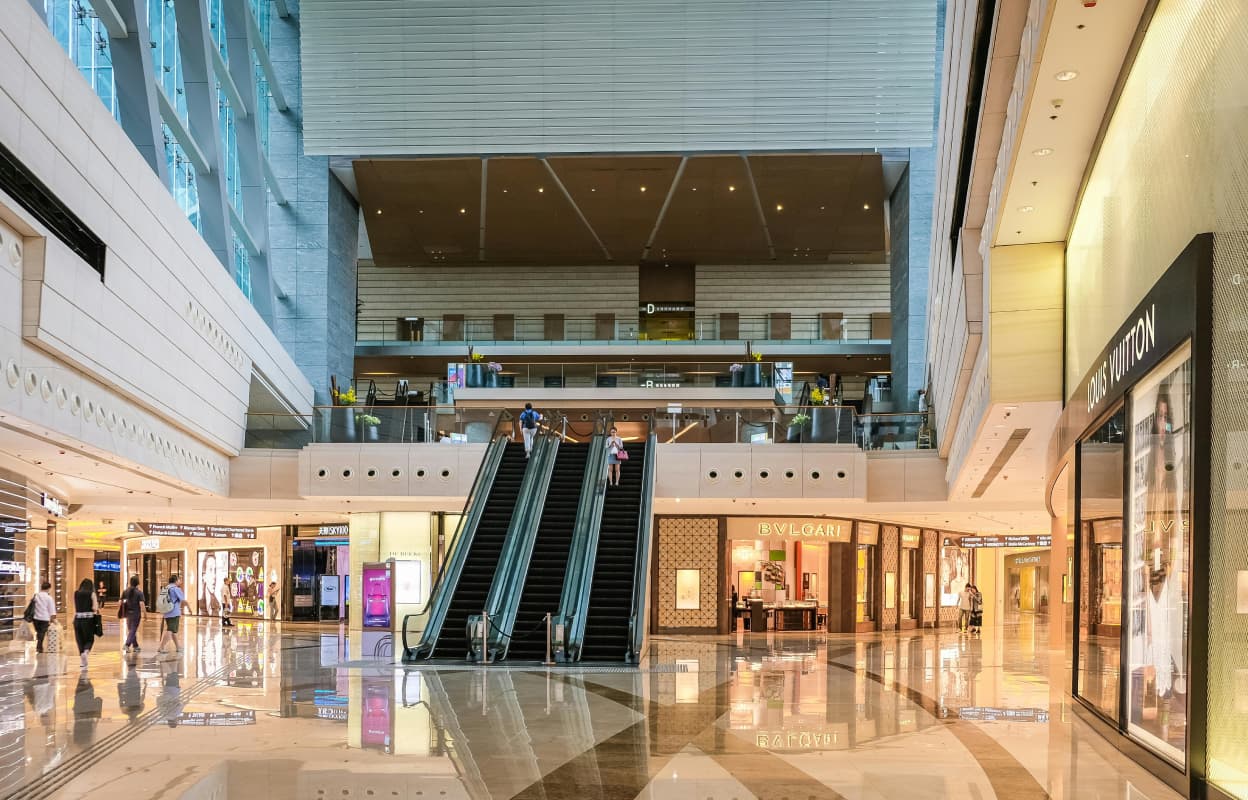
Now let’s focus on commercial facilities, where visitors arrive with a completely different emotional state. We often encounter the assumption in conversations that information islands are mainly aimed at new visitors or tourists. After all, regular customers will quickly learn the topography of the mall. However, nothing could be further from the truth!
We noticed a positive correlation between the frequency of visiting shopping malls and the frequency of using information kiosks. This result surprised us greatly because it can be concluded that even regular customers use these devices.
Investing in digital wayfinding tools means we cater to the needs of:
- People visiting the mall for the first time and wanting to find a specific shop.
- Foreign tourists who are unfamiliar with local brands but want to do some shopping.
- Regular customers who want to quickly reach their destination or check where their favourite shop has been moved.

Let’s move on to qualitative data
Respondents repeatedly highlighted the accuracy of the maps presented. They pointed out their easy accessibility and intuitiveness. This also aligns with our observation that many maps do not maintain appropriate standards of legibility. This is particularly noticeable in large malls, where a huge amount of information is presented at once, without paying attention to the cognitive abilities of our audience.
Preparing a “pretty” map packed with colourful graphics is not enough. Some designs may seem nice but are impractical. Appropriately balanced colour contrasts and the development of logical information architecture are crucial. A well-designed layout of keys and map arrangement means users can orient themselves better and, above all, effectively use the device.
Is it worth investing in digital wayfinding?
The situation is similar to that in hospitals. Offline wayfinding with extensive signage should still be the foundation. The application and interactive kiosk should be supporting tools. However, here shopping malls and their tenants gain additional marketing space.
Note that your customers can search for specific shops and brands on information islands and their own devices. This is an excellent way to analyse consumer trends and draw conclusions that support the strategic decisions of the facility.
Summary
If you are still reading this sentence, it means that the topic of wayfinding is important to you for some reason. This article is just an introduction to the conclusions brought by our extensive report from early 2025.
Our team regularly conducts analyses that help us make even better design decisions. If you want to learn more about how to improve the experience in your building, schedule a meeting.